
How to Become Job-Ready After Completing a Data Science Course
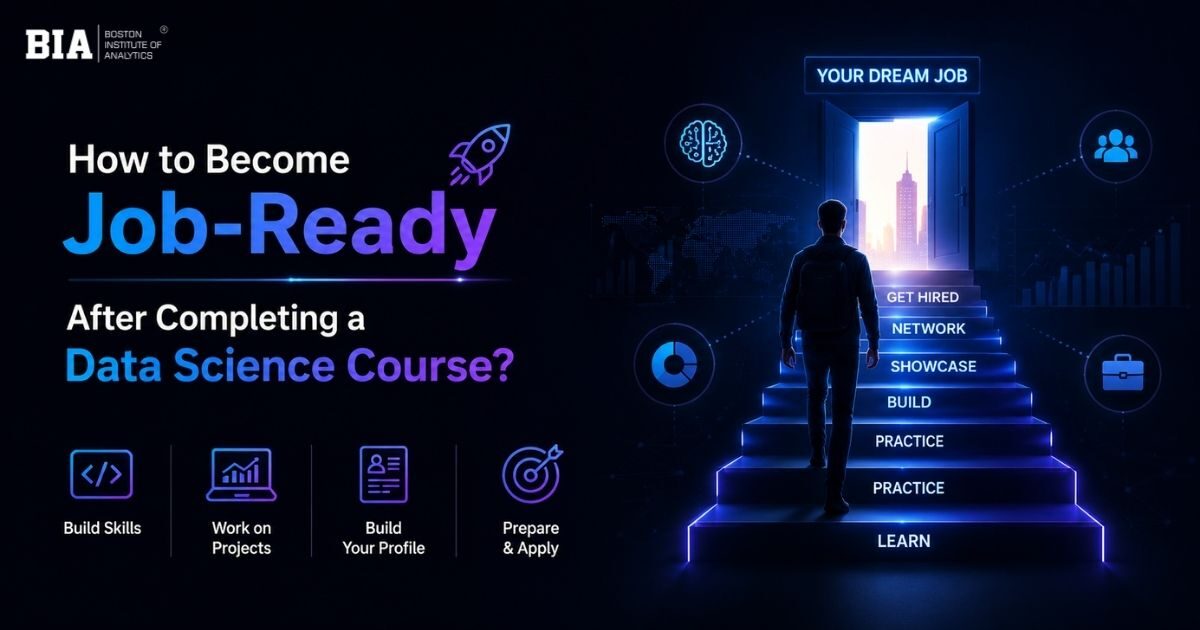
Completing a data science course does not automatically make you job-ready. You become employable when you can solve realistic problems, explain your decisions, present results clearly, and demonstrate your work through a credible portfolio.
This guide explains how freshers, working professionals, career changers, and beginners in India can turn data science training into evidence of job readiness. It also explains how to compare data science courses, institutes, and placement-support programs.
What do employers look for after a data science course?
- A certificate confirms course completion, but a portfolio demonstrates practical ability.
- Job-ready learners should be comfortable with Python, SQL, statistics, data visualisation, and machine learning fundamentals.
- Three to five well-documented projects are more useful than many unfinished projects.
- Each project should show the business problem, data preparation, analysis, model choice, results, and recommendations.
- Beginners can target data analyst, business analyst, junior data scientist, and reporting roles before specialising further.
- Interview preparation must include SQL, statistics, case studies, project explanations, and behavioural questions.
- The best data science course with placement support should provide mentor feedback, mock interviews, resume guidance, and employer-facing preparation.
- A practical 90-day plan can help learners move from course completion to applications with measurable evidence.
Why does completing a data science course not guarantee a job?
A completed course in data science will not necessarily provide employment since the recruitment panel looks at how competent you are rather than whether you have attended class or whether you are certified.
The World Economic Forum's Future of Jobs Report 2025 identifies AI and big data among the fastest-growing skill areas, while analytical thinking, resilience, flexibility, and collaboration remain important human skills.
This means job readiness has two dimensions:
- Technical readiness: You can work with data, tools, models, and code.
- Professional readiness: You can communicate findings and connect analysis to business outcomes.
Having a data science certificate is helpful if it comes from a good course that has been studied and assessed. However, it becomes less convincing if it is the sole indication of competency.
What does "job-ready" mean in data science?
A job-ready entry-level candidate should be able to contribute to a project from the business question through to a defensible recommendation, while clearly identifying when guidance is needed. The individual is able to state assumptions, identify data constraints, validate findings, and present a decision to an untrained stakeholder.
For example, a job-ready candidate should be able to:
- Translate "customers are leaving" into a measurable churn problem.
- Query customer and transaction data using SQL.
- Clean missing, duplicate, and inconsistent records.
- Explore patterns with Python or a visualisation tool.
- Build and evaluate a suitable model.
- Explain which factors influence churn.
- Recommend actions that a business team can test.
Which skills should you master after data science training?
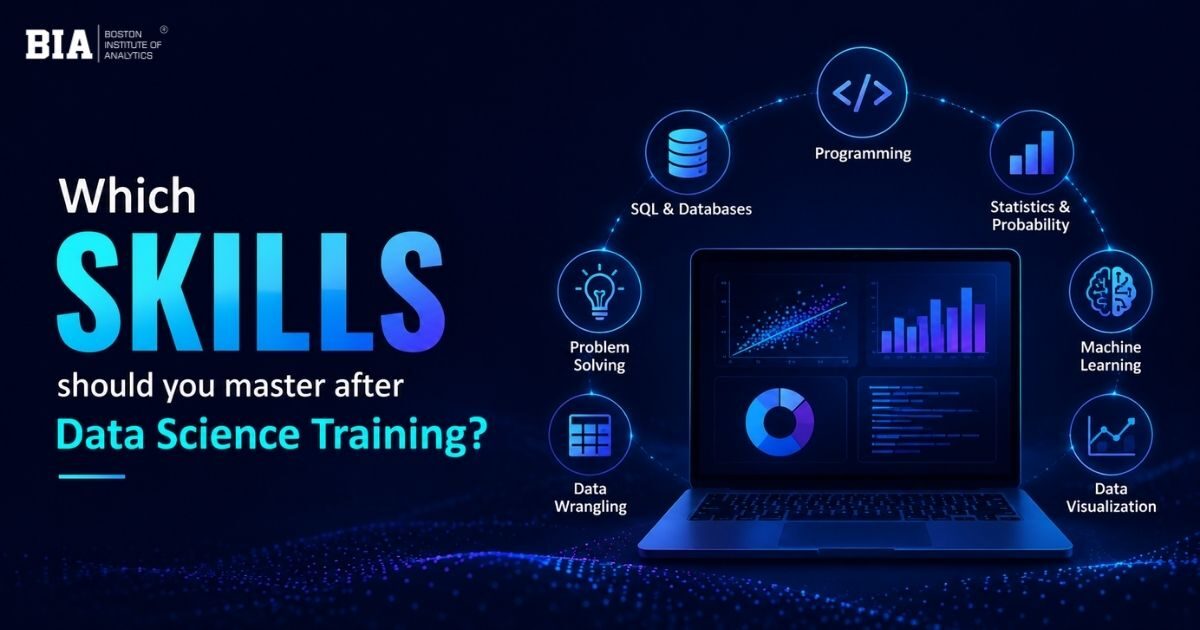
Before applying for any data-related positions, it is important to have a solid understanding of programming, data management, statistics, visualization, machine learning, and communication skills. Proficiency is key rather than accumulating a large set of technologies.
Python and SQL
Your first priorities should be Python and SQL since they are used for data manipulation and analysis as well as automation. Practice working with pandas, NumPy, functions, error handling, joins, aggregations, subqueries, common table expressions, and window functions.
You should be able to:
- Import and inspect datasets.
- Write reusable data-cleaning code.
- Join multiple tables correctly.
- Identify duplicate or inconsistent records.
- Calculate business metrics.
- Explain query logic during an interview.
Statistics and experimentation
Statistics helps you tell true patterns from randomness. Concentrate on descriptive statistics, probability, distribution, sampling, confidence intervals, hypothesis testing, correlation, regression, and A/B testing.
Formulas are not always needed to learn. Understanding why some technique is used and what it shows is crucial.
Machine learning fundamentals
Machine learning is all about decision making, not algorithms. Regression, classification, clustering, feature engineering, training/test splitting, cross-validation, overfitting, regularization, and model evaluation must be known to you.
Metric choice is problem-dependent. It can happen that accuracy is inappropriate for fraud detection in an imbalanced data set.
Data visualisation and storytelling
Data visualization is what transforms analysis into a decision that can be understood by others. Learn charts in Python and in some business intelligence tool like Power BI or Tableau.
A strong dashboard should answer:
- What happened?
- Why did it happen?
- Which segment matters most?
- What should the business do next?
Professional skills
Communication, analysis, teamwork, and problem-solving can influence the hiring process. According to the World Economic Forum, abilities of humans, including analytical thinking, resilience, flexibility, and teamwork, have continued to be significant along with technical skills.
How many projects should you build for a job-ready portfolio?
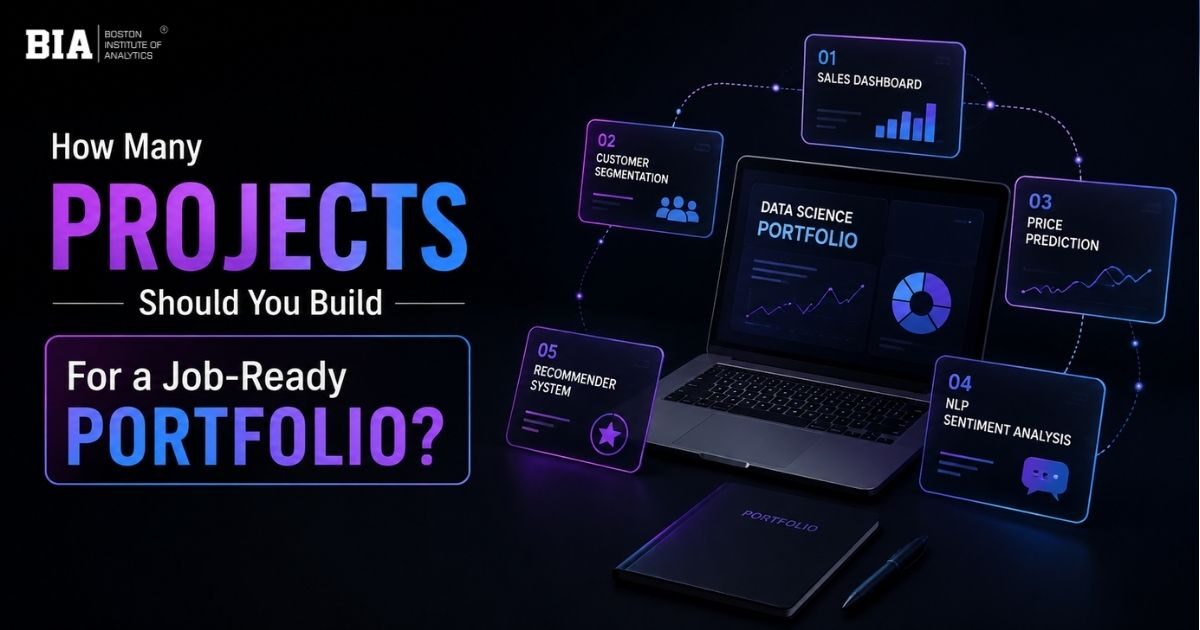
Complete three to five projects that fit your target job rather than producing multiple superficial notebooks. Ensure that each project highlights how you progressed from an undefined problem to an informed recommendation.
A job-ready portfolio should include different project types:
| Project type | Example | Skills demonstrated |
|---|---|---|
| Exploratory analysis | Retail sales performance | SQL, Python, trends, segmentation |
| Dashboard | Marketing campaign reporting | KPIs, visualisation, stakeholder communication |
| Predictive model | Customer churn prediction | Feature engineering, classification, evaluation |
| Forecasting | Demand or revenue forecasting | Time series, assumptions, validation |
| End-to-end project | Loan-risk assessment | Data pipeline, modelling, business recommendation |
What should every project contain?
- Business problem: State the decision the project supports.
- Dataset description: Explain the source, scope, fields, and limitations.
- Data preparation: Document missing values, outliers, duplicates, and transformations.
- Method selection: Explain why you chose a particular analysis or model.
- Evaluation: Report meaningful metrics and compare against a baseline.
- Business interpretation: Explain what the results mean.
- Recommendation: State what a stakeholder should do next.
- Reproducibility: Include clean code, a README file, and setup instructions.
"Titanic Prediction Using Python" is not as convincing as a project that will explain modelling choices, restrictions, and implications. It is alright to use popular data sets for learning purposes, but a unique approach is necessary.
How do you make a portfolio credible?
Ensure that your work can be easily audited in less than five minutes. You should use GitHub for your coding, a well-defined project README file, screenshots of dashboards, and a brief description of your reasoning.
Finally, your portfolio needs to exhibit ethical handling of data. Avoid leaking sensitive data, personal data, or any unsubstantiated statements. Describe whether the dataset is public, simulated, anonymized, or sourced from an open source.
Which roles can you target after a data science course?
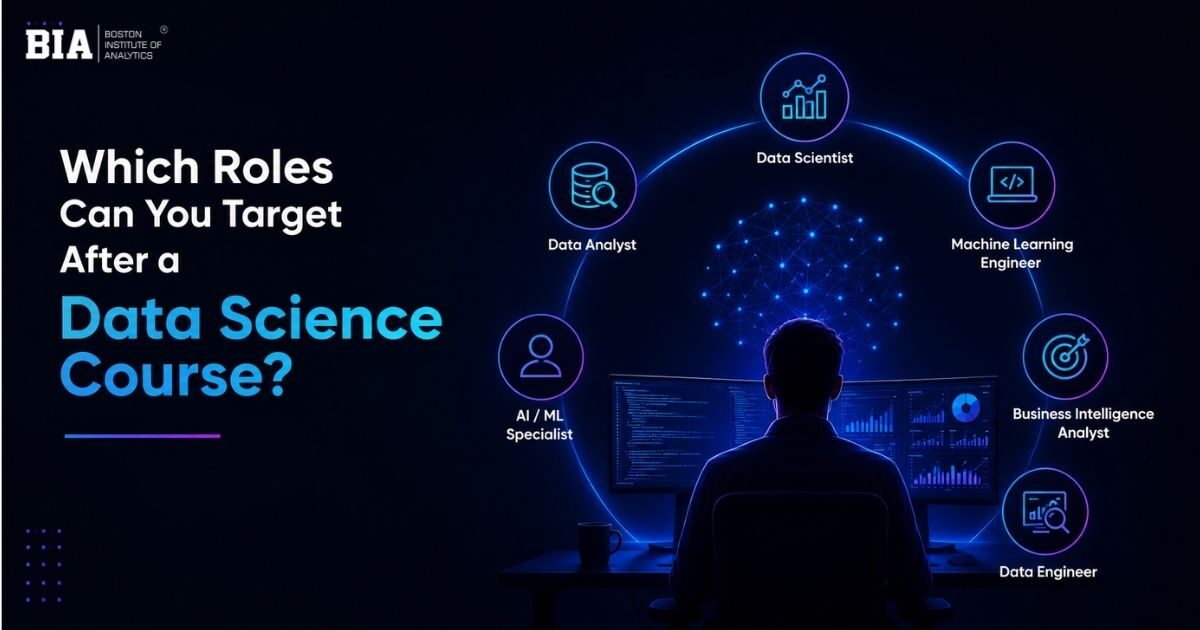
Most learners should initially target roles that fit their best proofs and not apply solely for "Data Scientist" jobs. These positions usually consist of: data analyst, business analyst, reporting analyst, junior data scientist, machine learning intern, and analytics consultant.
| Target role | Prioritise these skills | Strong portfolio evidence |
|---|---|---|
| Data analyst | SQL, Excel, Python, dashboards | KPI dashboard and business analysis |
| Business analyst | Requirements, metrics, communication | Process or performance improvement case |
| Reporting analyst | SQL, automation, visualisation | Automated reporting workflow |
| Junior data scientist | Python, statistics, machine learning | End-to-end predictive project |
| Machine learning trainee | Modelling, evaluation, deployment basics | Model API or documented deployment |
| Analytics consultant | Problem framing, storytelling, domain knowledge | Client-style case studies |
The practical first role can act as an excellent stepping stone into data science. For instance, a data analyst role that enables you to learn machine learning and experimentation can later enable you to join product analytics, data science, and machine learning engineering roles.
Your targeted role will dictate what you need to learn. Avoid spending months learning advanced deep learning concepts when your application is SQL-based analyst roles.
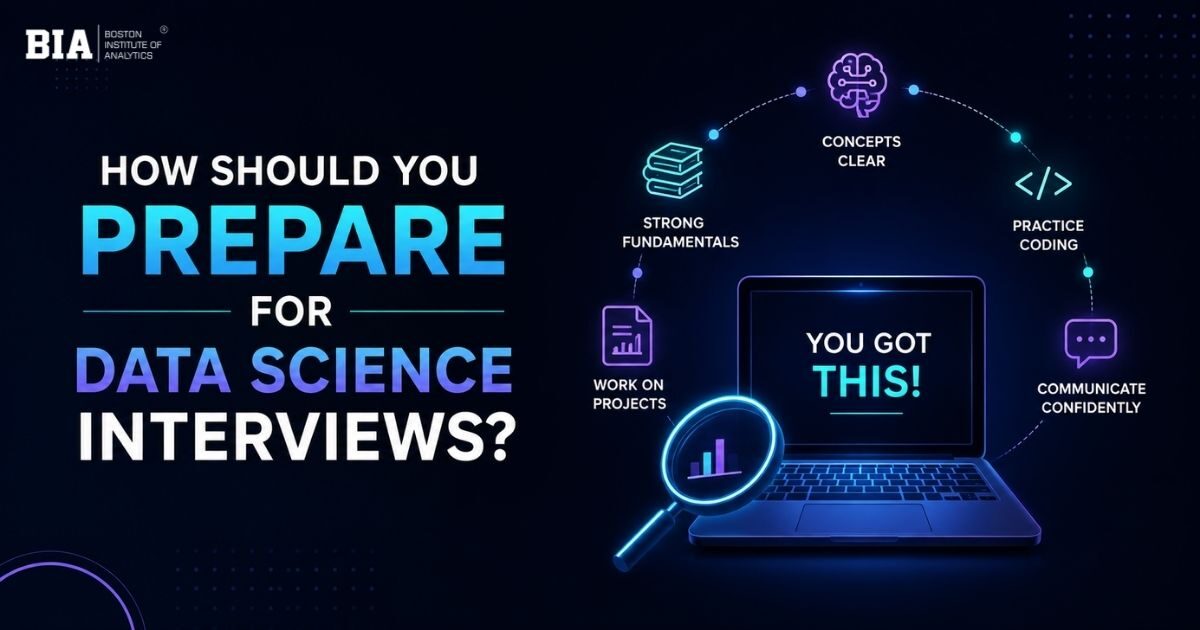
How should you prepare for data science interviews?
Get ready for interviews through a combination of technical preparation, project defence, business case studies, and communication training. An interviewee who is able to describe a project effectively tends to perform better than an interviewee who just knows definitions.
Technical interview preparation
Practise questions in four areas:
- SQL: joins, aggregations, window functions, ranking, dates, and data-quality checks.
- Python: data manipulation, functions, debugging, and basic algorithmic reasoning.
- Statistics: sampling, significance, distributions, correlation, and experiment design.
- Machine learning: model selection, overfitting, leakage, feature engineering, and metrics.
Do not prepare by memorising isolated answers. Write queries and code under time limits.
Project defence preparation
For each project, prepare a two-minute explanation covering:
- The business problem.
- The dataset and its limitations.
- The most important cleaning decision.
- The method and evaluation metric.
- The key result.
- The recommendation.
- What you would improve with more time.
Interviewers may challenge your expectations. A strong answer can allow limitations without abandoning the value of the analysis.
Case-study preparation
Practise structured responses to questions such as:
- Why did sales decline in one region?
- How would you measure the success of a recommendation system?
- How would you investigate customer churn?
- Which metric would you use for a fraud model?
- How would you design an experiment for a new product feature?
Begin with clarification. Define the metric. State your assumptions. Describe the analysis. End with a business action.
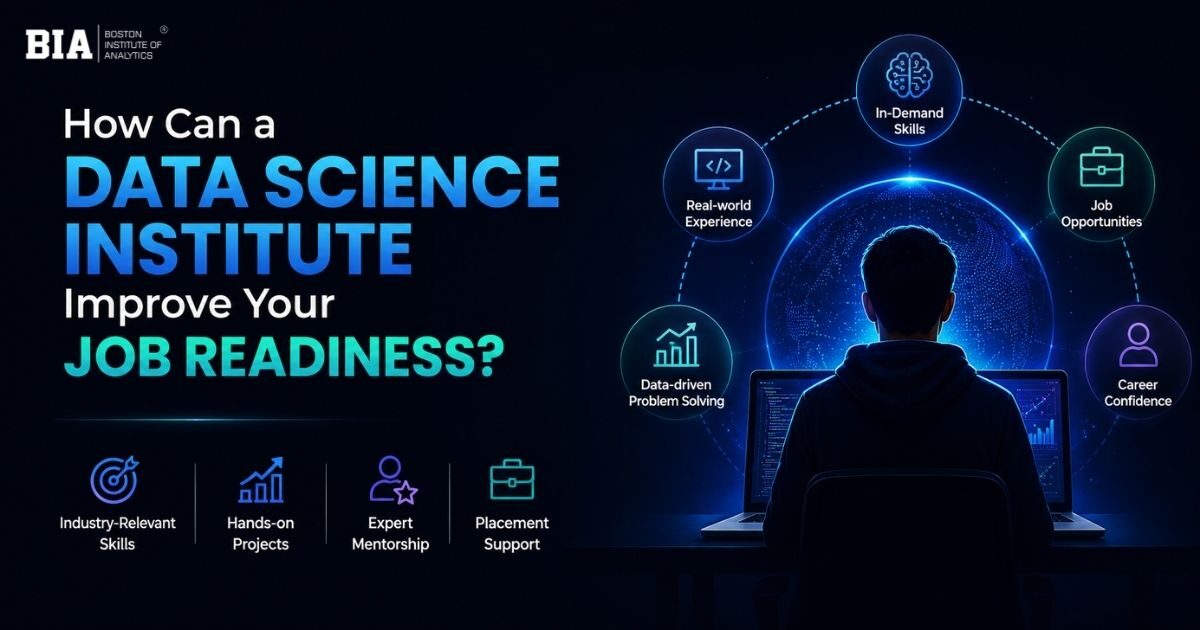
How can a data science institute improve your job readiness?
Job preparedness can be made much easier for an individual enrolled in a data science institute by ensuring that their education includes a combination of learning in addition to practical projects, mentor reviews, and interviews among other things.
Before selecting a data science program, evaluate these factors:
- Curriculum relevance: Does it cover Python, SQL, statistics, machine learning, visualisation, and practical applications?
- Project quality: Are projects end-to-end and reviewed by mentors?
- Faculty credibility: Can instructors explain their professional or academic experience?
- Assessment: Are learners tested through assignments, code reviews, presentations, and capstone work?
- Career support: Does the provider offer resume reviews, mock interviews, job-search strategy, and application guidance?
- Placement transparency: Are placement claims clearly defined and supported by verifiable information?
- Learning format: Does the schedule work for students and working professionals?
- Location and access: Are there suitable options for learners in Mumbai, Bengaluru, Chennai, Delhi, Thane, Hyderabad, and Pune?
- Post-course support: Can graduates receive continued mentorship while applying?
Government-backed FutureSkills PRIME, initiated by the Ministry of Electronics and Information Technology with NASSCOM, also reflects the importance of industry-aligned training in emerging technologies.
What does placement assistance usually include?
Help with placement must involve practical help during the entire job search process and not just listing of vacancies. These may include resume optimization, LinkedIn profile optimization, practice interviews, skill assessments, portfolio evaluation, career counselling, and advice on suitable jobs.
Placement assistance is not the same as a guaranteed job. Ask the provider to define:
- Whether "placement" means interview access or employment?
- Which roles and experience levels are included?
- Whether salary figures refer to fixed pay, total compensation, or estimates?
- How many learners completed the program?
- How outcomes are measured and reported?
- Whether support continues after the course ends?
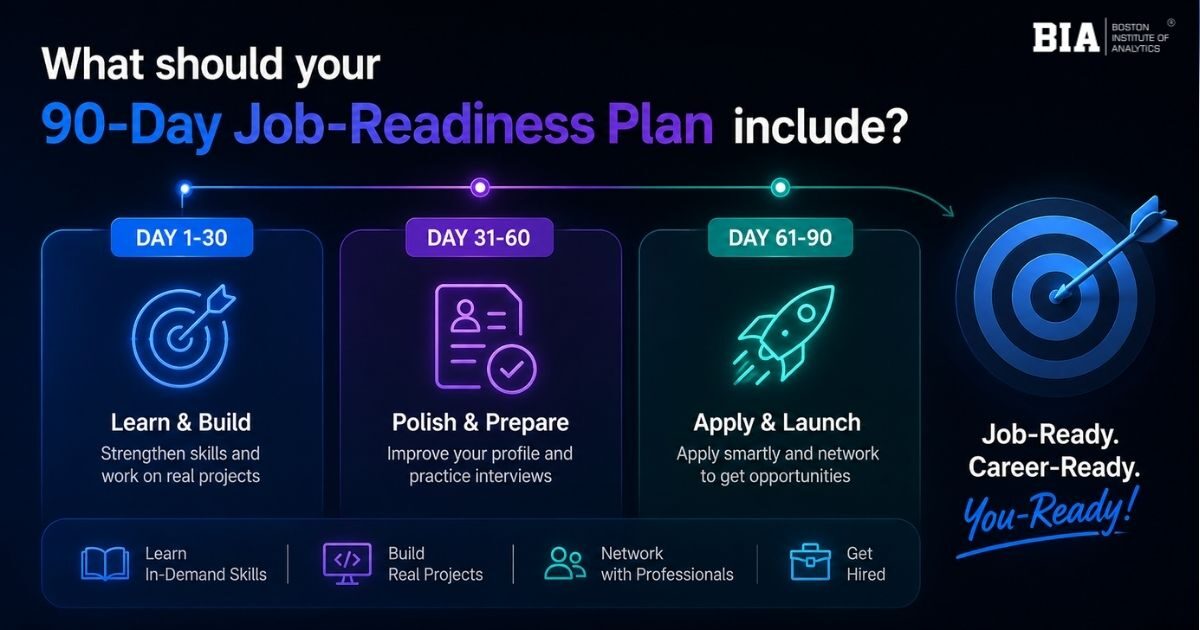
What should your 90-day job-readiness plan include?
A 90-day plan should convert learning into visible evidence, applications, and interview practice. Divide the period into three stages.
Days 1–30: Strengthen the foundation
During the first month: Identify your technical weaknesses and choose your target role. Perform timed SQL and Python exercises. Brush up on statistics and machine learning concepts. Choose two portfolio projects according to the job description of your choice.
Your outputs should include:
- A target-role statement.
- A skills-gap checklist.
- A cleaned GitHub profile.
- One completed analysis project.
- A weekly interview-practice schedule.
Days 31–60: Build and publish evidence
In the second month, work on another two projects. Provide business context, documentation, visualization, and model assessment. Have your code and explanations reviewed by a mentor or a fellow student.
Your outputs should include:
- Two polished project repositories.
- One dashboard or presentation.
- A one-page resume.
- A complete LinkedIn profile.
- A concise project explanation for interviews.
Days 61–90: Apply, practise, and improve
Use the final month to apply, practise, and improve yourself through regular application and feedback. Create an application table. Write down the interview questions. Make changes in your portfolio as per the employers' recurring question.
Your outputs should include:
- Targeted applications for suitable roles.
- Weekly mock interviews.
- Documented recruiter and interviewer feedback.
- Revised resume versions for relevant job families.
- A clear explanation of your preferred role and strengths.
Do not wait until you feel completely ready. The goal is to create a feedback loop in which applications reveal what to improve.
What is the best data science course in India for career outcomes?
The best data science course in India is the one which suits your starting point, job objective, timing, project objective, and requirements for professional help. There is no best course that suits all learners.
Use this selection checklist:
- Compare the curriculum against real job descriptions.
- Check whether projects use realistic business problems.
- Confirm that assignments receive meaningful feedback.
- Review instructor backgrounds and teaching approach.
- Ask how assessments measure practical ability.
- Verify the exact scope of placement assistance.
- Understand the time commitment and prerequisites.
- Speak with the institute about your target role before enrolling.
While evaluating the best data science course with placement, placement assistance can be considered as just one criterion of evaluation rather than the sole criterion. Training, authentic projects, interview skills, and career assistance go hand in hand.
A job-ready entry-level candidate should be able to contribute to a project from the business question through to a defensible recommendation, while clearly identifying when guidance is needed.
What is the next step after completing a data science course?
The next thing you do is pick up one target role, audit your skills in terms of that role's job description, and then create evidence in form of three to five projects related to that. Start applying while simultaneously preparing for interviews.
If you are comparing data science programs, review the curriculum, mentor feedback process, project structure, and career-support terms before enrolling. You can also request a course walkthrough from Boston Institute of Analytics to assess whether the program matches your target role.
Frequently asked questions
Is a data science certification enough to get a job?
Data science certification by itself usually isn't enough to land a job; employers expect technical expertise, evidence of completed projects, good communication skills, and good interview performance. The value of the certification increases when it shows an assessed practical performance.
Can I join a data science course without a technical background?
It is possible to participate in a data science course even if you don't have any technical knowledge, but you will need to be ready to develop coding, statistical, and analytical skills. Beginners should choose programs that provide appropriate support.
How many projects should I include in my portfolio?
There should be three to five completed and relevant projects in the portfolio. For each project, describe the business question, data preparation, methodology, assessment, result, and recommendation. It is more important to produce quality content rather than just fill the portfolio.
What jobs can I get after data science training?
Depending on your skills, you might become eligible for positions of data analyst, business analyst, reporting analyst, junior data scientist, machine learning trainee, or analytics consultant. You should choose your target position based on your skills portfolio.
Does placement assistance guarantee a job?
Placement assistance does not imply employment. It could help you in preparing yourself through resume assistance, mock interviews, portfolio reviews, career counselling, and related opportunities.
How long does it take to become job-ready?
It takes most students several months of practice after their training period is over. This will depend on their past experiences, hours spent in studying each week, technical skills gaps, portfolio, and interview performance.